

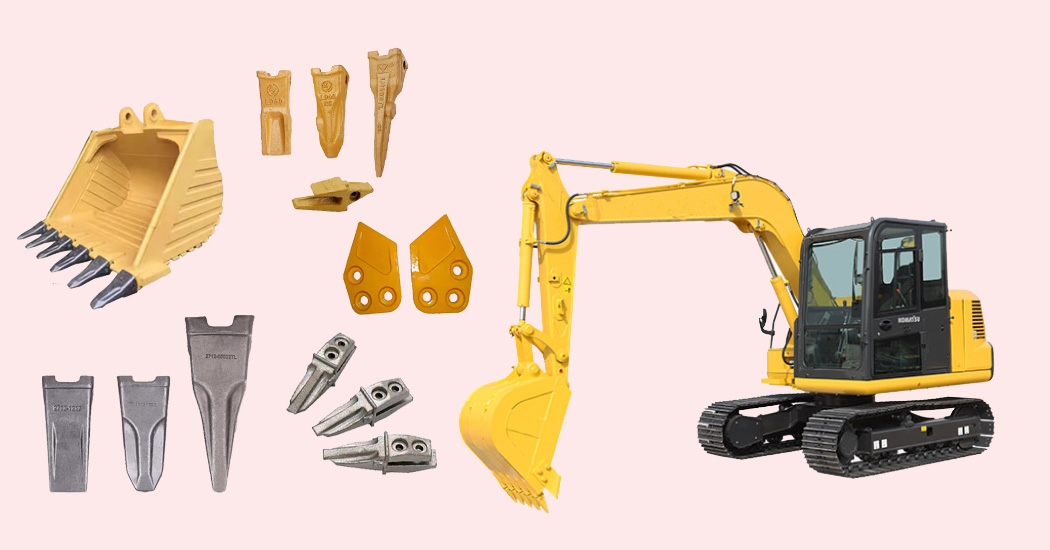
Excavator Digging Teeth Parts
Excavators serve as the “jack-of-all-trades” in modern construction, with their versatility largely dependent on interchangeable digging tools (attachments). Proper operation and meticulous maintenance of these tools are crucial for ensuring construction safety, boosting work efficiency, and extending equipment lifespan.
Let’s delves into the usage techniques and maintenance essentials for five common tools: hydraulic breakers, augers, rippers, wide buckets, and grid buckets.
1.Hydraulic Breakers: The Art of Powerful and Precise Impact
The hydraulic breaker, commonly known as the “hammer head,” is the core tool for demolition and breaking operations.
During operation, always maintain a perpendicular angle between the chisel and the surface of the material being broken. Angled strikes cause uneven force distribution on the chisel, increasing the risk of breakage and damaging the cylinder body.
Maintenance Essentials
- Regular Grease Application:Apply grease to the chisel-bush contact surface every 2 operating hours to reduce wear. This is the most critical daily maintenance task.
- Monitor nitrogen pressure:Regularly (recommended every 500 hours) check and replenish nitrogen in the front cylinder. Insufficient nitrogen pressure reduces impact force, while excessive pressure damages oil seals and the hydraulic system. Always adhere to the manufacturer’s.
- Inspect Fasteners: Due to intense vibration, all bolts on the breaker are prone to loosening. Critical bolts (e.g., side plate bolts, accumulator bolts) must be checked for tightness daily before operation.
2.Auger Drill: The Precision Tool for Rotary Deep Drilling
Underground Obstacles: Before drilling, thoroughly investigate for buried utilities like pipes or cables to prevent accidents and drill rod damage.
Speed and Pressure Adjustment: Optimize rotation speed and downward pressure for different soil types (clay, sand, rock) to achieve maximum drilling efficiency.
Maintenance Guidelines
- Clean the drill bit and auger blades:After each operation, promptly remove soil and weeds entangled on the drill bit and blades. Preventing hardening makes cleanup easier and maintains balance and efficiency for subsequent drilling.
- Lubricate critical components:Regularly apply grease to the drill rod’s keyways, drive shaft, and gearbox (if applicable), or replace gear oil to ensure smooth transmission.
- Inspect drill bit wear:The alloy teeth on the drill bit are wear parts. Regularly check their condition and replace or repair them promptly. Failure to do so significantly reduces drilling speed and increases fuel consumption.
3.Ripper: The “Rock-Breaking Teeth” for Hard Soil
The ripper is used for pre-processing hard ground, serving as the “pioneer” for enhancing overall excavation efficiency.
When working in rocky strata, locate natural cracks or bedding planes to position the teeth beneath them for maximum efficiency.
The ripper is designed for vertical or near-vertical prying. Do not use it for wide-angle lateral swinging or striking, as this can easily cause root or bracket fractures.
Maintenance Essentials
- Check Pins and Bushings: The ripper connects to the excavator via pins. Regularly inspect wear and lubrication of pins and bushings to prevent excessive play and abnormal noises caused by wear.
- Inspect Structural Components:Regularly check main supports, crossbeams, and other structural parts for cracks or deformation, especially welded areas.
4.Wide-Gauge Bucket: The Earth’s “Scraper” and “Smoother”
The wide bucket is primarily used for large-area land leveling and slope grading.
Modern excavator joysticks typically feature a “floating mode” button. During leveling operations, activate this function to allow the bucket to rest entirely on the ground under its own weight while being pulled by the machine. This achieves exceptionally smooth results.
Grading demands meticulous operation. Skillfully coordinate the combined movements of the boom, stick, and bucket for scraping, backfilling, and fine-tuning.
Maintenance Essentials
- Inspect cutting edges and side plates:The cutting edges and side plates are primary wear points. Regularly inspect their wear condition. Severely worn edges significantly impair grading accuracy and cutting ability; repair or replace promptly.
- Inspect Connecting Pins: Ensure pins and bushings connecting the bucket to the excavator are well-lubricated and free from excessive wear.
5.Grid Bucket: The “Screener” for Gold in Sand
Grid buckets efficiently sift and separate materials during excavation, offering high efficiency and environmental benefits.
Teeth experience the most rapid wear as they directly contact material. Regularly check tip wear. Replace or repair teeth via weld overlay when wear exceeds one-third of original length.
Modify the bucket angle to regulate screening speed and the particle size of screened material.
Maintenance Essentials
- Inspect Screen Structure: Regularly check screen bars for bending, fractures, or severe wear. Correct or reinforce promptly.
- Lubricate Moving Parts: Regularly lubricate pins and cylinders for bucket opening/closing mechanisms.
Strictly follow the maintenance manual to apply grease to all pins and bushings.
Keep adequate stock of wear parts like bucket teeth, ripper teeth, and drill bits for timely replacement. Avoid operating with damaged components to prevent further damage and greater losses.